
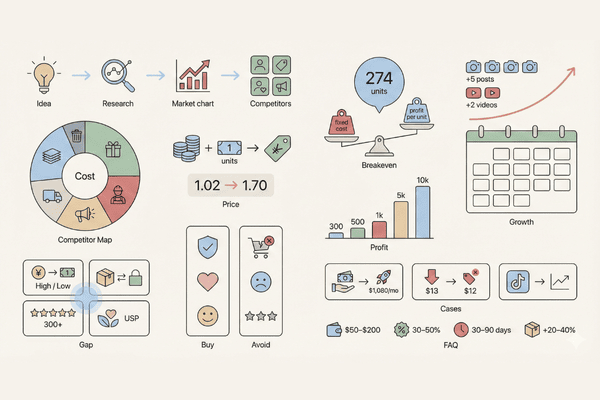
Many beginners want to start a product business. However, most of them rely on emotion instead of data and a package like product cost and pricing strategy. This is why so many new entrepreneurs fail. A profitable product business is built on mathematics, costing, pricing, customer psychology, competitor analysis, and consistency which leads to product business costing and pricing.
In this guide, you will learn exactly how to start a product business using reliable formulas, real USD-based calculations, and multiple case studies that show what works — and what fails in short – Product cost and Pricing Strategy.
This guide applies to skincare, fashion, accessories, digital items, home tools, or any physical product business. A complete product cost and pricing strategy package is here.
1. What You Need Before You Start a Product Business
✔ Validate the Market
Before you start a product business, you must understand the demand.
Check:
- What problem does your product solve?
- How many people face this problem?
- What are customers searching for?
- What price are they comfortable with?
Use tools like Google Trends and competitor reviews to understand demand. A package like product cost and pricing strategy will get a structure soon.
✔ Identify Customer Pain Points
Customers buy products that solve pain points.
Identify:
- What customers dislike about existing products
- Missing features
- Packaging problems
- Overpricing
- Lack of trust
Pain points reveal your opportunity.
✔ Define Your Unique Selling Proposition (USP)
To start a product business successfully, you need a USP.
Examples:
- Better packaging
- Cleaner ingredients
- Faster delivery
- Lower price
- Premium branding
- Transparent communication
A USP differentiates you in a crowded market.
⭐ 2. How to Calculate Product Cost (Unit Economics)
One of the most important steps in learning how to start a product business is understanding cost calculation.
✔ Total Cost Formula
Total Cost = Materials + Packaging + Labor + Marketing + Storage + Logistics + Wastage
✔ Unit Cost Formula
Unit Cost = Total Cost ÷ Number of Units
👉 Example (500 units)
| Cost Item | Cost (USD) |
|---|---|
| Materials | $230 |
| Packaging | $90 |
| Labor | $70 |
| Marketing | $60 |
| Storage + Logistics | $45 |
| Wastage (3%) | $15 |
| Total Cost | $510 |
Unit Cost = $510 ÷ 500 = $1.02
Your unit cost must be calculated scientifically, not emotionally.
⭐ 3. Pricing Strategy: How to Price a Product for Profit
Pricing is one of the biggest reasons why beginners fail. Many people set a selling price without calculating profit margin.
Use this proven formula:
✔ Professional Pricing Formula
Selling Price = Unit Cost ÷ (1 – Profit Margin)
👉 Example
- Unit cost = $1.02
- Target profit margin = 40%
Selling Price = 1.02 ÷ 0.60 = $1.70
Recommended price: $1.75–$2.00
This ensures profit even after delivery or marketing costs.
⭐ 4. Breakeven Analysis: How Many Units You Must Sell to Survive
Breakeven tells you how to start a product business without losing money.
✔ Breakeven Formula
Breakeven Units = Fixed Costs ÷ (Selling Price – Unit Cost)
👉 Example
- Fixed cost = $200
- Selling price = $1.75
- Unit cost = $1.02
Breakeven = 200 ÷ 0.73 = 274 units
You must sell 274 units per month to avoid loss.
Anything above breakeven becomes profit.
⭐ 5. Competitor Analysis Framework
When you start a product business, competitors provide the best data.
✔ What to Compare
- Price
- Ingredients/materials
- Packaging
- Branding
- Customer reviews
- Complaints
- Marketing style
- Delivery time
Competitors reveal what customers want — and what they don’t.
✔ Gap Analysis Questions
- What are they missing?
- What can I improve?
- How can I offer more value with minimal cost?
Gap analysis helps you build positioning.
⭐ 6. Customer Psychology: Why People Buy (or Don’t Buy)
To start a successful product business, you must understand buyer psychology.
✔ Why Customers Buy
- Trust
- Clear benefit
- Fair price
- Good packaging
- Reviews from real people
- Easy ordering
✖ Why Customers Don’t Buy
- Confusing information
- Cheap packaging
- No reviews
- Overpricing
- Weak branding
- Delayed replies
Your marketing must address both logic and emotion.
⭐ 7. Organic Growth Strategy: 60-Day Content Plan
To grow without ads, follow this organic content strategy.
✔ Daily Content Frequency
- 4–5 posts/day
- 1–2 videos/day
✔ Content Types
- Educational tips
- Product demonstration
- Customer reviews
- Problem–solution content
- Packaging showcase
- Offers
- TikTok/Reels hooks
- Behind-the-scenes
✔ Timeline
- Day 30 → reach increases
- Day 45 → followers grow
- Day 60 → inquiries start
- Day 90 → consistent sales
Posting consistently builds authority and trust.
⭐ 8. Profit Projection (How Much You Can Earn)
If profit per unit = $0.73
| Units Sold | Monthly Profit |
|---|---|
| 300 units | $219 |
| 500 units | $365 |
| 1,000 units | $730 |
| 5,000 units | $3,650 |
| 10,000 units | $7,300 |
Scaling becomes easier when your systems are strong.
⭐ 9. Real Case Studies (USD-Based)
🧪 Case Study 1: Started With $100 → Grew to $1,080/Month
- 50 units produced
- Profit per unit: $1.20
- 900 units sold by month 6
- Monthly profit: $1,080
Simple consistency multiplied success.
🧪 Case Study 2: Clothing Business Failure
- Cost = $13
- Selling = $12
- Negative profit = -$1 per sale
They didn’t understand costing → disaster.
🧪 Case Study 3: TikTok Growth Example
- 2 videos/day
- Strong demo content
- 1,300 units sold in month 2
- Monthly profit: $680+
Videos = fastest growth engine.
⭐ 10. FAQ (Yoast + Schema Optimized)
✔ What is the minimum budget to start a product business?
You can start with $50–$200 depending on the product.
✔ What is the ideal profit margin?
Aim for 30–50%.
✔ How long does it take to see results?
Expect results within 30–90 days of consistent content posting.
✔ Is packaging important?
Yes, packaging can increase conversion by 20–40%.
✔ Should I run ads immediately?
No. Build trust through organic content first.
⭐ Conclusion: Build with Data, Not Emotion
Now you know how to start a product business using real science — costing, pricing, customer psychology, competitor analysis, profit modeling, and organic content.
Success becomes predictable when you follow the formulas.
⭐ Call to Action
For infographic, pricing calculator, or consultation:
📞 +8801401100660
📧 info@rupantok.com