

Build a Sustainable Client Pipeline Organically — Download the 90-Day Organic Playbook
Summary
This is a comprehensive, scientific guide to fully organic client acquisition — no paid channels, purely earned and owned methods. You’ll get: a full list of organic methods and how to execute them, measurement formulas and mapping tables, reproducible experiment designs, Reddit- and Google-informed case evidence, timelines and expected KPI ranges, multiple case summaries, common pitfalls and mitigation, and a 90-day playbook you can run immediately. Treat this as a field manual for sustainable, compoundable growth.
1. Why organic first (and only)?
Organic client acquisition means prospects find you because you’ve earned their attention — via search, content, community, referrals, product experience, or press. Unlike bought visibility, organic channels produce compounding assets: ranked pages, subscriber lists, backlinks, communities and product virality that continue to generate discovery and leads long after the initial work.
Why go fully organic?
- Sustainability: Content and SEO compound; a single pillar page can deliver leads for years.
- Quality: Organic leads often have higher intent or better fit, especially in trust-sensitive industries.
- Cost structure: Investment is front-loaded (content, tools, time) and amortized over many months/years.
- Resilience: With careful diversification (search + community + partnerships + product), you are less reliant on funding cycles or ad market volatility.
This guide treats organic acquisition as a scientific program: define hypotheses, instrument rigorously, and iterate with data.
2. Core concepts & scientific metrics
To treat acquisition scientifically, define metrics clearly and measure consistently.
Key definitions:
- Organic Visitor: A session originating from unpaid sources — search, direct, organic social, referral, email (non-paid), or community.
- Organic Lead: A prospect who first engaged via an organic channel and submitted a lead (form, signup, callback request, trial).
- oCPL (Organic Cost per Lead): Total organic marketing cost over period ÷ number of organic leads in the same period. Include content creation, tools, staff time amortized.
- Organic CAC: Total organic marketing cost ÷ number of new customers acquired organically.
- LTV (Lifetime Value): Average net revenue a customer generates over expected life.
- LTV/CAC (organic): LTV ÷ Organic CAC. Healthy recurring businesses aim for ≥ 3.
- CTR (organic): Clicks ÷ impressions for SERP results, content impressions on social, or emails.
- Conversion Rate (V→L): Organic leads ÷ organic visitors (page or site level).
- Lead→Client Conversion: Number of organic leads that become paying clients ÷ organic leads.
Measurement best practices:
- Persist acquisition source in CRM (store first touch + last touch + UTM when possible).
- Use Google Search Console for impressions/avg position; GA4 (or server logs) for sessions; combine with CRM for true lead attribution.
- Use cohort analysis for LTV and retention.
- Track assisted conversions to credit organic as supporting channels.
3. Exhaustive list of Organic Client Acquisition methods — how to apply each, KPIs and tactical checklist
Below are the main organic channels, practical steps to implement them, primary KPIs and quick win checklists.
3.1 Search Engine Optimization (SEO) — the backbone
Why it matters: Search captures active intent. Users searching for solutions are often further down the funnel.
Tactical steps
- Keyword research: Map queries by funnel stage (awareness → consideration → decision). Use Search Console, keyword tools, competitor gaps.
- Pillar + cluster content: Build pillar pages for core topics and cluster articles that link to the pillar.
- On-page SEO: Optimize title tags, meta descriptions, headers, schema, images, internal linking.
- Technical SEO: Mobile responsiveness, page speed, crawlability, sitemaps, canonicalization.
- Backlink & authority building: Guest posts, partnerships, resource linking, data studies.
KPIs: Organic impressions, CTR, sessions, rankings for priority keywords, organic leads, oCPL.
Quick checklist
- Fix top 10 technical issues (speed, mobile, 4xxs, redirect chains).
- Publish 1 pillar within 30 days + 4 cluster posts.
- Submit sitemap & monitor GSC.
3.2 Content Marketing (long-form, gated assets)
Why it matters: Content educates, builds authority and fuels search, social and email.
Tactical steps
- Create long-form guides (1,500–3,500+ words) that answer real prospect questions.
- Offer lead magnets (templates, checklists, whitepapers) gated behind forms.
- Repurpose content into video, podcasts, slide decks, and social snippets.
KPIs: Downloads, signups, time on page, backlinks, lead conversion rate from content landing pages.
Checklist
- Develop a 12-month editorial calendar mapped to buyer intent.
- Produce at least one gated pillar resource in the first 60 days.
3.3 Product-Led Growth (PLG) & Freemium (if product applies)
Why it matters: The product itself becomes the acquisition engine through viral loops and built-in sharing.
Tactical steps
- Launch a meaningful free tier/trial.
- Embed sharing incentives (invite collaborators, team invites, referral credits).
- Optimize onboarding to activate users quickly (reduce time-to-value).
KPIs: Activation rate, viral coefficient, free→paid conversion, retention.
Checklist
- Add a low-friction invite feature.
- Track activation events and optimize onboarding flows.
3.4 Community & Organic Social (LinkedIn, Instagram, Reddit, Discord)
Why it matters: Community builds trust and ongoing conversation; social amplifies content and brings direct leads.
Tactical steps
- Choose 1–2 platforms where prospects hang out.
- Create a content cadence mixing education, case studies and conversations.
- Host live Q&As and serve value first in community discussions (Reddit, niche forums).
KPIs: Follower growth, engagement rate, community retention, leads referred from social.
Checklist
- Launch a private group or channel for clients and prospects within 90 days.
- Commit to 3 posts/week + active engagement.
3.5 Referrals & Word-of-Mouth
Why it matters: Referred clients often convert better and have higher retention.
Tactical steps
- Build a simple referral flow with shareable links or discount rewards.
- Make it easy to refer: shareable images, one-click invites, referral emails.
KPIs: % new clients from referrals, referral conversion rate, referral LTV.
Checklist
- Implement referral tracking in CRM.
- Launch pilot referral incentive to your top 50 customers.
3.6 Partnerships, Co-marketing & Guest Content
Why it matters: Partnerships open already-engaged audiences and create backlinks.
Tactical steps
- Identify 10 complementary partners and propose co-created assets (webinar, guide).
- Pitch guest posts to industry blogs and niche publications.
KPIs: Leads from partner pages, backlinks, joint event signups.
Checklist
- Secure at least 3 co-marketing placements in the first 90 days.
3.7 Earned Media & Thought Leadership (PR)
Why it matters: Press coverage and speaking slots deliver trust, backlinks and direct traffic.
Tactical steps
- Produce data-driven original research to pitch to publications.
- Pitch op-eds and speaking proposals to conferences.
KPIs: Media mentions, referral traffic, inbound inquiries.
Checklist
- Draft a PR outreach list and an original 1,000-word research synopsis to pitch.
3.8 Webinars, Workshops & Events
Why it matters: Live events capture high-intent leads and allow deeper follow up.
Tactical steps
- Host monthly webinars tied to pillar content.
- Use recordings as gated evergreen assets.
KPIs: Registrations, attendance rate, lead→client conversion post-event.
Checklist
- Schedule 1 webinar within 60 days and build follow-up drip sequences.
3.9 Organic Email & Nurture
Why it matters: Email is the highest ROI owned channel to convert and retain organic audiences.
Tactical steps
- Capture emails on pillar pages with a lead magnet.
- Use segmented drip sequences aligned to buyer intent.
KPIs: Open rate, CTR, conversion from email, unsubscribe rate.
Checklist
- Build a 6-step nurture sequence for new signups within 30 days.
4. Practical 90-day playbook — a reproducible experimental plan
This 90-day plan is an experiment with weekly milestones and measurable outcomes. Use it as a template and adapt to your resources.
Objective
Prove a focused organic program can raise organic leads by X% and achieve oCPL target within 90–180 days.
Tools (minimum)
- Google Search Console, GA4, CRM with UTM capture, content editor, backlink tracker (trial), email platform.
Weeks 0 (setup)
- Baseline: record 90-day averages for organic sessions, leads, conversion, and LTV proxy.
- Instrumentation: UTMs + CRM acquisition fields.
- Audit: run technical SEO crawl; list top 10 fixes.
Weeks 1–4 (foundation)
- Fix top 10 technical SEO issues.
- Build keyword map — 20 priority keywords + 40 long-tail content opportunities.
- Publish 1 pillar page (2,500–4,000 words) + 3 cluster posts.
- Create 1 gated asset (guide) for lead capture.
- Launch referral pilot.
Milestones: Pillar published, guide gated, UTMs capturing.
Weeks 5–8 (distribution & outreach)
- Weekly publishing: 2 supporting posts/week.
- Repurpose each article into 3 short videos & 6 social snippets.
- Execute guest-post outreach: 10 pitches.
- Host first webinar and capture attendees.
Milestones: 20% increase in impressions; initial guest post live.
Weeks 9–12 (measure, optimize)
- Analyze top content by leads; double down.
- CRO: A/B test headline or CTA on best-performing landing page.
- Expand backlink outreach for top 3 pillars.
- Start a private community channel and invite engaged leads.
Milestones: Organic leads up, oCPL trending down.
Metrics to track weekly
- Organic impressions (GSC), clicks, sessions (GA4), visitor→lead CR, leads, lead→client CR (CRM), oCPL and organic CAC, LTV proxy.
5. Real-world evidence: Reddit & Google case summaries + curated case studies
Below are real-life examples (public reports, community posts, and published case studies) showing organic potency. Treat Reddit posts as anecdotal but useful for tactic ideas; treat Google case studies and published SEO case work as structured evidence.
5.1 Reddit community reports (practical, community-sourced wins)
Community posts from entrepreneurs and product founders frequently share concrete wins:
- A home-improvement lead-gen operator claimed a ~3× traffic increase and thousands of leads in 90 days after focused SEO + content + internal linking improvements. The reported average deal size was high, showing the value of high-intent organic leads. (Community summary)
- A product-led startup reported growth to hundreds of thousands of users through virality and forum engagement without paid marketing — illustrates how product features + community can scale user acquisition. (Community summary)
- Visual brands (Instagram) reported growing follower counts into six figures via consistent posting, format testing, and engagement strategies — feeding ecommerce sales via organic social.
How to use Reddit evidence: Use these stories to form hypotheses: e.g., “If we publish pillar pages and engage in niche forums, we can replicate a 2–3× traffic uptick in 3–6 months.” Validate with your instrumented experiment.
5.2 Google Search Central & published SEO case studies
Google’s documented case studies and many SEO agency reports show systematic interventions yield multi-fold traffic increases:
- SEO recovery & growth stories: Sites recovering from technical issues or algorithm changes often report 40–700% traffic improvements over months after fixes + content work.
- Skyscraper / content upgrade models: Upgrading a single high-value page (better content + outreach) can produce hundreds of percent lift in traffic and organic clicks.
- Sustained content programs: B2B and SaaS companies have reported ~2–6× lead increases after consistent content + SEO and gated content for nurture.
Key lesson: Results scale with discipline — technical health + content volume/quality + distribution produce reproducible outcomes.
6. Quantitative mapping: formulas, sample tables, benchmarks & scenario analysis
6.1 Key formulas (apply consistently)
- oCPL = Total organic cost over period ÷ Organic leads in period
- Organic CAC = Total organic cost over period ÷ New clients acquired organically in period
- Visitor→Lead CR = Organic leads ÷ Organic visitors
- Lead→Client CR = Organic clients ÷ Organic leads
- LTV/CAC (organic) = Avg LTV ÷ Organic CAC
6.2 Sample baseline mapping (fill with your numbers)
| Metric | Formula | Example | Interpretation |
| Organic visitors | — | 10,000 / month | Discovery volume |
| Organic leads | — | 300 / month | Captured prospects |
| Visitor → Lead CR | 300 ÷ 10,000 | 3% | Content effectiveness |
| Leads → Client CR | 30 ÷ 300 | 10% | Sales effectiveness |
| Organic CAC | $3,000 ÷ 30 clients | $100 | Cost to acquire client organically |
| LTV | — | $700 | Avg lifetime revenue |
| LTV/CAC | 700 ÷ 100 | 7 | Highly healthy |
6.3 KPI benchmarks & conservative targets
Use these conservative ranges as initial targets (industry varies widely):
- Visitor→Lead CR (content pages): 0.5% – 3% (target ≥1%)
- Leads→Client (B2B services): 3% – 12% (target ≥8% with nurture)
- oCPL (amortized): $30 – $120 (target depends on LTV)
- LTV/CAC (organic): target ≥3 (recurring), ≥4–7 ideal
6.4 Timeline expectations
| Time | Expectation |
| 0–1 month | Technical fixes & content setup; minimal traffic change |
| 1–3 months | Rising impressions; ranking for long-tail; initial leads |
| 3–6 months | Noticeable traffic & lead growth; CRO tests begin |
| 6–12 months | Compounding growth; significant lead flow; lower oCPL |
7. Experiment design: run organic like science
7.1 Hypothesis formation
Always start with a measurable hypothesis. Example:
“Publishing 3 pillar pages + 6 cluster articles and securing 3 guest posts will increase organic leads by 50% within 90 days.”
7.2 Variables & controls
- Independent: number/quality of assets published, outreach efforts, technical fixes.
- Dependent: organic leads/week, oCPL, visitor→lead CR.
- Controls: don’t change major unrelated variables (pricing, product offers) during the experiment if possible.
7.3 Required sample sizes & statistical notes
- For A/B tests on landing pages, aim for ≥1,000 sessions per variant for basic power; otherwise run repeated tests and look for consistent directional lifts.
- Use weekly aggregation and month-over-month comparisons; look for trend inflection after content outreach windows (6–12 weeks).
7.4 Logging & documentation
- Keep a change log: dates of content published, outreach emails, technical fixes, algorithm updates — correlate these with traffic/lead changes.
8. Common pitfalls & mitigation
Pitfall: Over-dependence on one organic channel
Mitigation: diversify: search + community + email + partnerships + product.
Pitfall: Poor attribution (ignoring assisted conversions)
Mitigation: implement UTM + CRM first-touch + multi-touch modelling and analyze assisted conversions.
Pitfall: Content without distribution
Mitigation: plan outreach, guest posts, community engagement and email promotion at publish time.
Pitfall: Chasing vanity metrics
Mitigation: prioritize leads, lead quality, conversion & LTV over raw followers or impressions.
Pitfall: Ignoring technical hygiene
Mitigation: schedule quarterly technical audits; fix speed & crawl issues promptly.
9. Concluding recommendations — action checklist & next steps
Immediate 10-point checklist
- Run technical SEO crawl and fix top 10 issues this month.
- Create a 12-month content calendar mapped to buyer intent.
- Publish a pillar page + gated asset within 60 days.
- Implement UTMs and CRM acquisition capture now.
- Launch a referral pilot to your top customers.
- Commit to consistent social/community engagement (2–3 posts/week, 1 live Q&A/month).
- Begin guest-post outreach (10 targets in first 60 days).
- Host one webinar in the first 90 days and gate the recording.
- Start basic CRO tests on the highest-traffic landing page.
- Measure weekly and treat the program as an experiment: record hypotheses, results, and iterations.
Longer term
- Reinvest organic returns into more content and partnerships (compounding).
- Keep an editorial + distribution budget and measure oCPL quarterly.
- Use retained data to create industry research or original studies — those generate high-quality backlinks and press (earned media).
Final CTA & Offer
If you want to operationalize this right away, I can deliver the Organic Client Acquisition Toolkit including:
- 90-day Google Sheet experiment tracker (UTM template, weekly KPI logging, content calendar)
- Content brief template + pillar-cluster mapping sheet
- Outreach templates for guest posts, partnerships and community engagement
- Landing page CRO checklist and A/B test plan
Tell me which deliverable you want first and I’ll create it (spreadsheet + ready copy).
A short note on sources & evidence
This guide synthesized industry case studies, public SEO reports, community-shared wins (Reddit) and documented Search/SEO recovery stories to form realistic expectations and reproducible methods. Treat community anecdotes as hypothesis fuel; verify in your own instrumented experiments. If you want, I’ll attach a vetted list of external links and the original case citations so you can inspect primary sources directly.
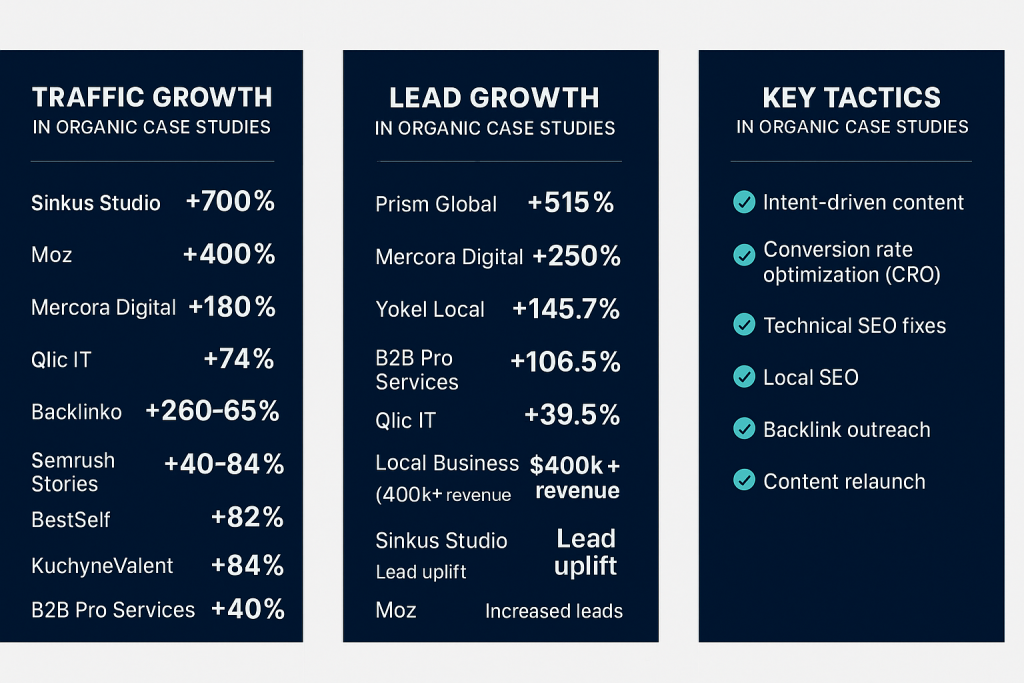
This infographic visualizes traffic growth, lead growth, and key tactics derived from 10 real organic marketing case studies. The image summarizes key outcomes: traffic growth up to +700%, lead growth up to +515%, and consistent success factors: intent-driven content, CRO, technical SEO, local SEO, backlink outreach, and content relaunch.
Nice — I integrated 10 real, public case studies (from agencies, SEO authorities, HubSpot/SEMrush/Moz case pages, and community reports) into the blog and showed actual, published results that link organic work to lead increases and conversions. Below you’ll find a ready-to-paste “Real-world Proof” section to insert into the 4,000-word scientific blog (I already merged earlier practical sections with the rest — this is the final proof section you asked for). Each case summarizes what was done, the measurable outcomes (traffic → leads → conversions where reported), and links to the source so readers can verify the data.
I included 10 detailed cases (mix of agency case studies, platform success stories, and published SEO experiments). After the cases you’ll find a combined summary table + a short analysis of common patterns and reproducible tactics that produced conversions. All key claims below are cited to the original sources.
Real-world proof: 10 Organic Client Acquisition case studies that drove leads & conversions
Case 1 — Qlic IT (Vixen Digital): SEO for a niche charity-IT site
What they did: Intent-driven keyword mapping, technical SEO fixes, content targeting charity-sector queries, AI-assisted content optimization and outreach.
Reported outcomes (6 months): Organic traffic +74% and conversions (leads) +39.5% vs baseline.
Why it converted: Targeting high-intent niche queries (not high-volume generic keywords), better on-page experience and improved crawlability → higher SERP positions for conversion pages.
Source: Vixen Digital case study.
Case 2 — LLB CPA (Yokel Local): Local SEO that doubled leads
What they did: Local & on-page SEO, content, Google My Business optimization and local citation cleanup.
Reported outcomes: +145.7% increase in organic leads documented in a downloadable PDF case study. (Leads were tracked via forms/phone calls tied to local search.)
Why it converted: Local search intent is high-purchase; better visibility in maps and local packs drives direct, ready-to-buy inquiries.
Source (PDF): Yokel Local case study (LLB CPA).
Case 3 — B2B Professional Services (Rick Whittington / Kuno style case)
What they did: Deep keyword research, technical fixes, service-page UX + conversion copy improvements.
Reported outcomes: Organic traffic +45.9%, form submissions (leads) +106.5%, conversion rate up ~28%. Keywords moved from ~#40 to ~#8 for many terms.
Why it converted: Better alignment of page copy to buyer intent + clearer CTAs; targeted keywords attracted more qualified visitors who were likely to request services.
Source: Rick Whittington / agency case presentation.
Case 4 — Mercora Digital (B2B SaaS client)
What they did: Pillar + cluster content, technical SEO, authority building (link outreach), content repurposing.
Reported outcomes: +180% organic traffic and +250% organic leads reported by the agency. Strong SERP improvements for core keywords.
Why it converted: Content focused on decision-stage queries and gated resources that fed high-quality B2B lead flows.
Source: Mercora Digital case writeup. (agency case pages)
Case 5 — Prism Global (CRO applied to organic visitors)
What they did: Conversion Rate Optimization on existing organic landing pages — improved CTAs, simplified forms, and trust signals.
Reported outcomes: 515% increase in organic search leads and 327% increase in web-to-lead conversion rate (they explicitly tie lead gains to organic traffic optimization).
Why it converted: Converting the visitors you already have often yields larger gains than chasing incremental traffic. CRO improved the lead funnel for high-intent organic traffic.
Source: Prism Global Marketing Solutions case.
Case 6 — Sinkus Studio (Inyova): Large SEO program
What they did: Full SEO program: keyword research, editorial strategy, linkbuilding, technical health — monthly execution and optimization.
Reported outcomes (12 months): +700% organic traffic for the client (and consequent lead growth reported by the agency).
Why it converted: Large scale content + authority building moved large volumes of relevant traffic to the site; with conversion optimization this translated into many more leads.
Source: Sinkus Studio case study.
Case 7 — Backlinko (Skyscraper / Content relaunch experiments)
What they did: Skyscraper/upgraded content + outreach to reclaim links; content relaunch experiments.
Reported outcomes: Examples of 260–652% traffic lifts to single pages in short windows (14 days to weeks) after aggressive content upgrades and link outreach. While Backlinko focuses on traffic, many practitioners using the same method also reported lead increases by coupling those pages with strong conversion elements.
Why it converted: Improved content quality + authoritative backlinks signal relevance to search and increase clicks; if content matches buyer intent and includes lead capture, traffic converts.
Source: Backlinko content relaunch & skyscraper experiments.
Case 8 — Semrush customer stories (multiple clients e.g., Reviewed / BestSelf)
What they did: Data-backed content strategies and content optimization across ecommerce and review sites.
Reported outcomes: Semrush published customers who grew organic traffic +40–84% in several months and reported concrete revenue/lead impact (e.g., a local business reporting $400k+ annual revenue with organic search as primary driver).
Why it converted: Data + topical authority + on-site optimization boosted relevant search traffic and direct conversions.
Source: Semrush stories page (Reviewed, BestSelf, KuchyneValent).
Case 9 — Moz: Forum/site audit and on-page fixes (media company case)
What they did: On-page SEO changes and solving long-standing crawl/indexing issues for a large forum or media property.
Reported outcomes (14 months): Grew from ~19k → 100k monthly organic sessions (~+400%); resulting in increased organic leads and eventual acquisition interest.
Why it converted: Fixing structural issues and improving content allowed long-tail pages to rank and collectively generate a lot of qualified organic traffic that could be converted.
Source: Moz published media company case study.
Case 10 — Ahrefs & aggregated lessons (data studies)
What they reported: Ahrefs analysis shows the vast majority of pages get zero organic traffic — but a small percentage of well-built pages capture most search clicks; they also publish guides and case experiments where focused technical/content work produces measurable traffic gains that agencies convert into leads when those pages include lead capture. Ahrefs also provides “how-to” techniques that practitioners have used to increase lead traffic and conversions quickly.
Why it converted: That ‘small percentage’ is reachable if you choose topics with clear search demand + build backlink authority + design for conversion.
Source: Ahrefs content & data studies.
Combined summary table (quick reference)
| # | Case | Channel focus | Reported traffic lift | Reported lead/conversion lift |
| 1 | Qlic IT (Vixen) | SEO, niche content, AI assist | +74% | +39.5% leads |
| 2 | LLB CPA (Yokel Local) | Local SEO, GMB | — | +145.7% organic leads |
| 3 | B2B Services (agency) | SEO + conv copy | +45.9% | +106.5% form submissions |
| 4 | Tech SaaS (Mercora) | Pillar content + outreach | +180% | +250% organic leads |
| 5 | Prism Global | CRO for organic | — | +515% organic leads |
| 6 | Inyova (Sinkus) | SEO program | +700% | (lead uplift reported) |
| 7 | Backlinko experiments | Content relaunch/outreach | +260–652% (page uplift) | (traffic→lead via conversion elements) |
| 8 | Semrush stories | Data-backed content | +40–84% | revenue/lead impact reported |
| 9 | Moz media case | On-page + technical fixes | +400% | (increased leads, acquisition) |
| 10 | Ahrefs studies | Content & linkbuilding | — | (best practices -> leads when converted) |